Graphs - Basics and Advanced
- Time allotted: 1 Week
- 5 weekdays - study and solve problems
- Saturday - revision and mocks
- Sunday as buffer
- Total questions: 55
- N150 questions: 19
- Primary study source: Structy
- Question break-up:
- 19 N150 questions - 13 basics and 6 advanced
- 11 - Structy - Graph 1
- 13 - Structy - Graph 2
- 21 - N250 - basics (13 overlapped with N150)
- 10 - N250 - advanced graph (6 overlapped with N150)
There are two types of graph questions so far
- Grid/Matrix-based graph questions (Neecode)
- Iterative + DFS Code with visited set
- Typical graph traversal questions (Structy and then Neetcode)
to-do:
- add structy questions into sheet
Day wise break-up:
- {15Q} Day 1 - complete Structy - Graph 1 - 4 to 5 hours
- 11 from structy + 5 related from N150/N250 - course schedule I, Number of Islands, Max Area of Island, Island perimeter, Number of connected components in undirected graph
- Day 2 - complete Structy - Graph 2
- 13 from structy
- Day 3 - Remaining N150
- Day 4 - Advanced graphs from N250 (10)
- Day 5 - Remaining N250
Kick-start notes
- Structy - https://structy.net/problems/graph-intro
- Basic problems
- Traversal
- Path finding
- Cycle detection
- Basic mantra
- graph = nodes + edges
- Directed vs undirected
- Neighbors and Adjacency list
- Pro tips
- js object keys are string - take care of them while making adjacency list object.
Pro-coding notes
Build adjacency graph from edge tuples
undirected graph

for directed graph - just add graph[a].push(b). Also see String usage

White-grey-black cycle detection algo
- visited vs visiting: at any time - node can be either of these sets
- only for DAG - otherwise it will detect a cycle
- white - unexplored
- grey - visiting
- black - already visited prev
- Iterative code to start the iteration
- Sample problem - https://structy.net/problems/premium/has-cycle
- When you meet a visiting node again - ITS a CYCLE
- O(e) run time, O(n) space for sets


Visited Set - when to insert
Try to insert into visited when also inserting into queue (or something similar) so that you always act on “valid” things. e.g. - Shortest Path code
const shortestPath = (edges, nodeA, nodeB) => {
  const graph = buildGraph(edges);
  const visited = new Set([ nodeA ]);
  const queue = [[ nodeA, 0 ]];

  while (queue.length > 0) {
    const [ node, distance ] = queue.shift();

    if (node === nodeB) return distance;

    for (let neighbor of graph[node]) {
      if (!visited.has(neighbor)) {
        visited.add(neighbor);
        queue.push([ neighbor, distance + 1 ]);
      }
    }
  }

  return -1;
};

const buildGraph = (edges) => {
  const graph = {};

  for (let edge of edges) {
    const [a, b] = edge;
    if (!(a in graph)) graph[a] = [];
    if (!(b in graph)) graph[b] = [];

    graph[a].push(b);
    graph[b].push(a);
  }

  return graph;
};
Island Count
const islandCount = (grid) => {
  const ROWS = grid.length;
  const COLS = grid[0].length;
  let islands = 0;
  let visited = new Set();

  let getKey = (r, c) => r + "," + c;

  const explore = (r, c) => {
    if(r <0 || r >= ROWS) return false;
    if(c <0 || c >= COLS) return false;
    if(visited.has(getKey(r,c))) return false;
    if(grid[r][c] === 'W') return false;

    visited.add(getKey(r,c));

    explore(r -1, c);
    explore(r+1, c);
    explore(r, c-1);
    explore(r, c+1);
    return true;
  }

  for(let r=0; r < ROWS; r++){
    for(let c=0; c < COLS; c++){
      if(explore(r ,c)) islands++;
    }
  }

  return islands;
};

module.exports = {
  islandCount,
};
Min Island
const minimumIsland = (grid) => {
  let minIsland = Infinity;
  const ROWS = grid.length;
  const COLS = grid[0].length;
  let visited = new Set();

  let getKey = (r, c) => r + "," + c;

  const explore = (r, c) => {
    if(r <0 || r >= ROWS) return 0;
    if(c <0 || c >= COLS) return 0;
    if(visited.has(getKey(r,c))) return 0;
    if(grid[r][c] === 'W') return 0;

    visited.add(getKey(r,c));

    return 1 + explore(r -1, c) + explore(r+1, c) + explore(r, c-1) + explore(r, c+1);

  }

  for(let r=0; r < ROWS; r++){
    for(let c=0; c < COLS; c++){
      const thisIsland = explore(r ,c);
      if(thisIsland > 0)
        minIsland = Math.min(thisIsland, minIsland);
    }
  }

  return minIsland;
};

module.exports = {
  minimumIsland,
};
Quick Tips
- Please understand what kind of visited you need.
- Is it a visited set for backtracking? Delete current cell from visited once done with it. Why? https://neetcode.io/problems/matrixDFS
- When we’re searching for all possible paths (backtracking problems, e.g. word search, unique paths, flood-fill with multiple routes)
- We add the cell to
visitedto prevent cycles during the current DFS path. - Once we’ve finished exploring from that cell, we remove it (
visited.remove((r, c))) so that other paths can reuse the same cell. - Without removing, future DFS calls starting from different branches wouldn’t be able to visit this cell, even though logically it’s valid for a different path.
- If it just to avoid going there back - u dont need to delete it. https://neetcode.io/problems/matrixBFS
- Is it a visited set for backtracking? Delete current cell from visited once done with it. Why? https://neetcode.io/problems/matrixDFS
- In BFS/DFS - when handling queue/stack and visited together: try to update both together. e.g. https://neetcode.io/problems/matrixBFS
- that prevents adding any cell again in queue.
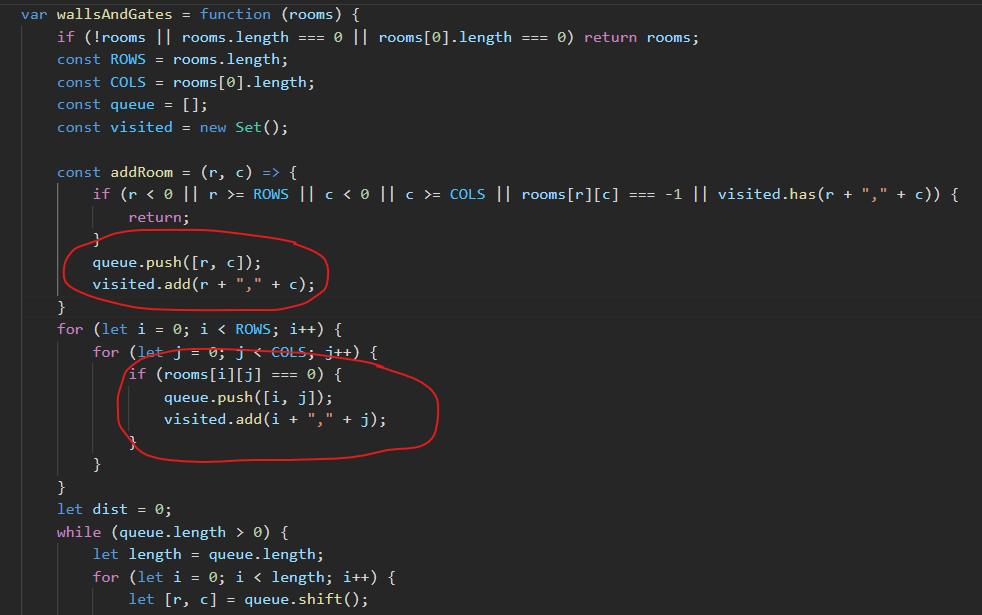
- that prevents adding any cell again in queue.