Base32 Encoding
https://en.wikipedia.org/wiki/Base32
You can encode binary data into Base32 using various methods depending on the programming language you're using. Base32 encoding represents binary data in a text format using 32 printable ASCII characters.
Base32 Alphabet
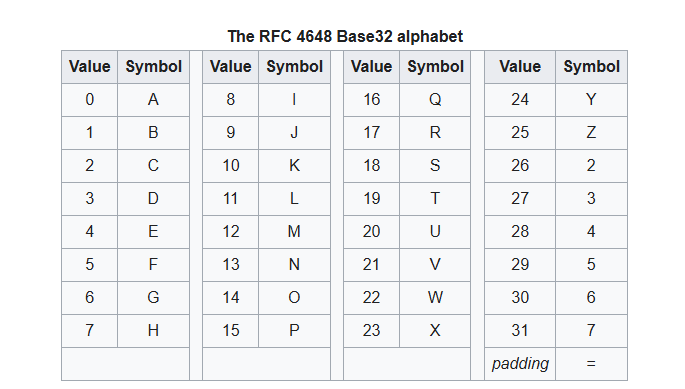
Base32 encoding uses the following 32 characters:
ABCDEFGHIJKLMNOPQRSTUVWXYZ234567
It does not use numbers 0 and 1 to avoid confusion with letters O and I.
Encoding Steps
-
Convert Binary to 5-bit Chunks
- Base32 represents data in 5-bit chunks.
- Pad with
0bits if necessary to form complete 5-bit groups.
-
Map to Base32 Alphabet
- Each 5-bit chunk is mapped to a Base32 character.
-
Add Padding (
=) if Needed- If the original data isn't a multiple of 5 bits, padding (
=) is added.
- If the original data isn't a multiple of 5 bits, padding (
Example in Python
Python provides base64 module, which supports Base32:
import base64

data = b'hello'  # Binary data
encoded = base64.b32encode(data)
print(encoded.decode())  # Output: NBSWY3DP
Example in JavaScript
const { encode } = require('hi-base32');

const binaryData = Buffer.from("hello");
console.log(encode(binaryData)); // Output: NBSWY3DP
Would you like a specific implementation in another language?